Wise Men from the East

Who Were the Wise Men, Really?
Matthew 2:1
Now after Jesus was born in Bethlehem of Judea in the days of Herod the king, behold, wise men from the East came to Jerusalem…
The wise men (or magi) are a Biblical staple in the story and celebration of Christmas. However, modern America tends to paint a picture of the wise men who went to worship Jesus as one way, but the Bible might actually portray them differently. If there are differences, what are they? Who are these men of mystery, these mysterious strangers?
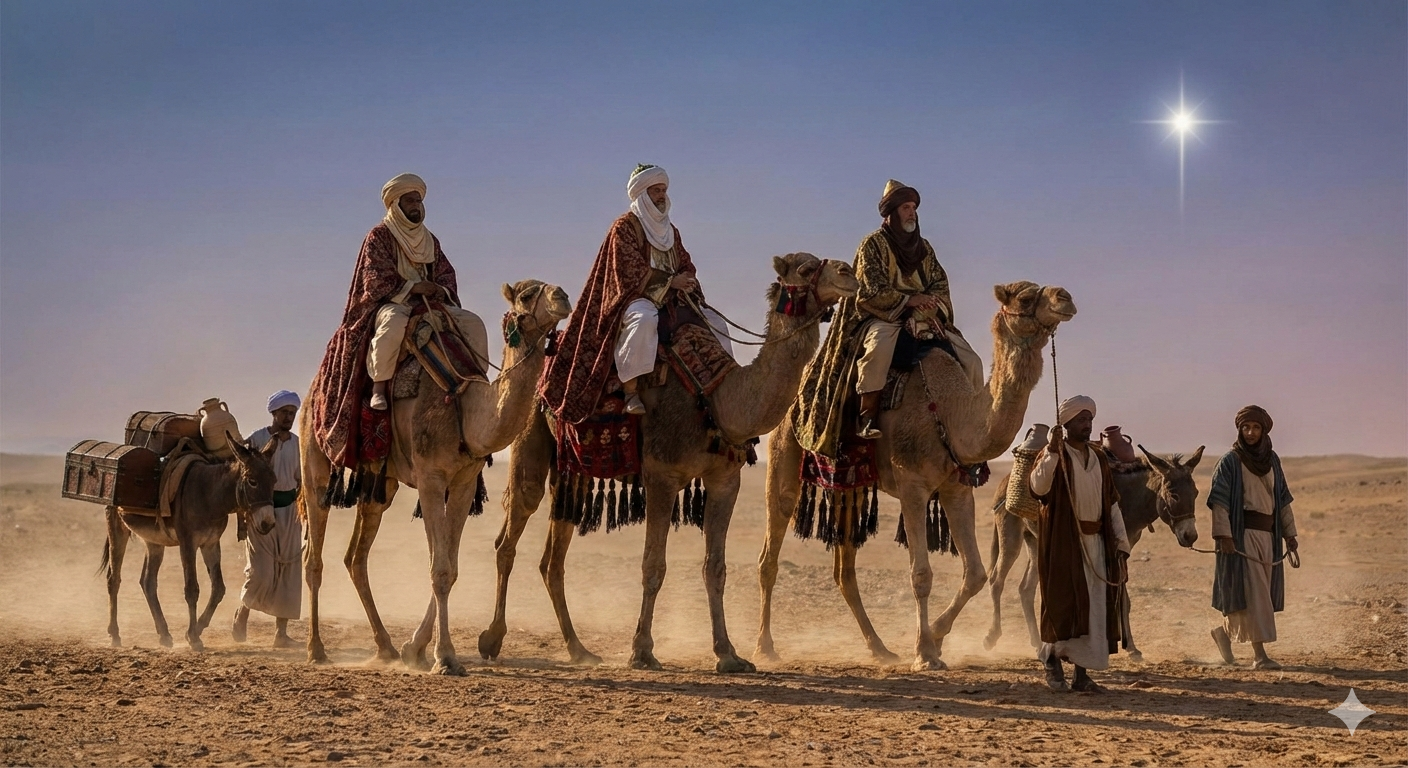
In our modern day, the wise men are usually portrayed as three in number, traveling with their camels, and present at the birth of Jesus. However, is this modern image accurate? Let’s take a moment and find out.
The wise men’s part of the Christmas story is found in Matthew 2:1-11.
Many people believe that they must have been astrologers. That is a possibility since the term magi (Greek: μάγος - magos) can relate to people practicing astrology or magic. The word can also be applied to teachers, physicians, magistrate advisors, or religious leaders. Finally, it applies to scholars of ancient writings, or scientists, such as astronomers. In other words, they were more than likely a mixture of many of those disciplines.
These wise men were high ranking officials. They were not kings, though. Neither the Bible nor any ancient document state that. History says at one point, they attempted to overthrow the Persian empire. After the attempt was unsuccessful, they ended up advisors to kings. Interestingly, it seems that ancient magi show up in the book of Daniel as advisors to King Nebuchadnezzar.
The magi may have very well come from Persia, as history tells us, which was more than several hundred miles to the east. They probably would have been followers of the religion of Zoroastrianism. Their god would have been Ahura Mazda (yes, Mazda). However, they would have likely been influenced by the Prophet Daniel’s work, specifically Daniel 9:24-27, which speaks of the Messiah. In addition, due to the Prophet Balaam’s close proximity to the area in times past, some scholars argue that they might have even been familiar with Balaam’s prophecy found in Numbers 24:17.
Our traditions tell us that there were three wise men. However, most people traveled with an entourage back then with more than three, especially in long distances. The idea of three men probably came from the fact that three gifts were given. Plus, an idea arose in the middle ages, stating their names were Melchior, Caspar (or Gaspar), and Balthasar. Some believe that to be true, but Scripture doesn't verify that anywhere.
Matthew 2:1 states that the wise men didn’t go to Jerusalem until after Jesus’ birth. Moreover, they traveled several hundred miles, which would have taken ample time. Unfortunately, they would not have been with Jesus as an infant in the stable. Matthew 2:11 calls Jesus a “young Child,” leading many scholars to believe He was over a year old when the magi arrived. Finally, Matthew 2:11 states that they saw Jesus in a house. It doesn’t mention a stable, barn, or cave. They arrived long after Jesus’ days in the stable.
Whatever we think of them, these magi made wise decisions throughout the story. They:
- Did their research
- Trusted the word of God
- Pursued Jesus
- Submitted to the word of God
- Continued to pursue Jesus
- Humbled themselves to worship Jesus
- Understood His importance as royalty
From all of that, and more, we can see that the magi were not exactly what modern society has made them into. Although there are some glaring differences, there are similarities, too. Instead of getting angry with modern commercialism, I actually find myself praising God that there are still people out there that include godly things and biblical stories in Christmas celebrations.
At the same time, be in prayer for our world today. There is, and has been, such a focus on Santa Claus and presents that we have forgotten the reason for Christmas in the first place. The next time we see an accurate or inaccurate depiction of the wise men, let's let it remind us to pray and tell the true story of a loving Savior.
John 3:16
...God so loved the world that He gave His only begotten Son, that whoever believes in Him should not perish but have everlasting life.