Original Languages of the Bible

I hear people talk about the original languages of the Bible sometimes. What does that mean and what are those languages?
2 Peter 1:21
… prophecy never came by the will of man, but holy men of God spoke as they were moved by the Holy Spirit.
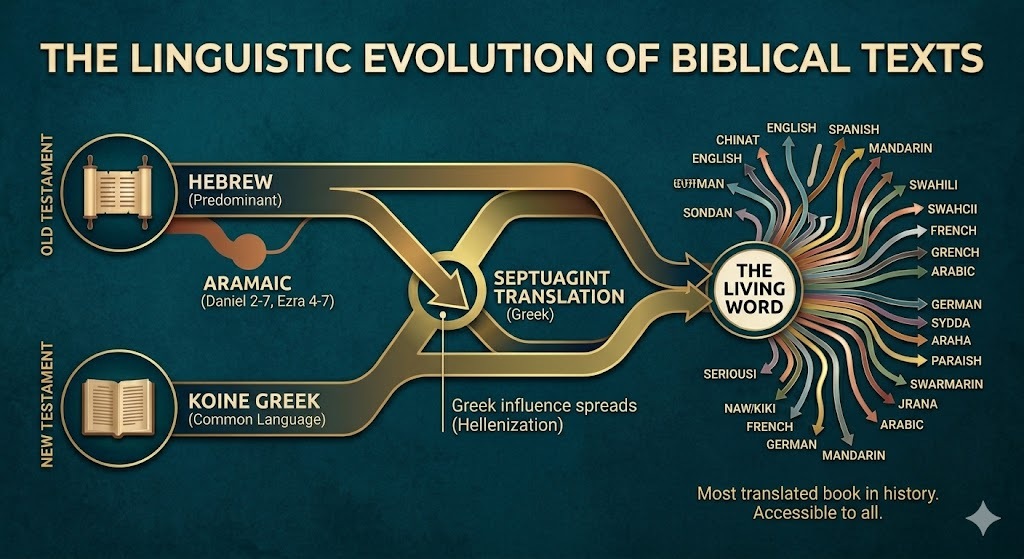
That is a good question. The Old Testament was originally written on scrolls by Israel’s prophets, like Moses, Isaiah, Daniel, Ezekiel, etc. The Old Testament was originally written in Hebrew, mostly. There were a few passages originally written in Aramaic, such as Daniel chapters 2-7 and Ezekiel chapters 4-7. There was another verse or so in Jeremiah, but that’s it. All of the rest of the Old Testament was written in Hebrew.
The New Testament was originally written by Jesus’ apostles, for the most part, such as Matthew, John, Paul, Peter, etc. They wrote it in Koine (Common) Greek, which we find much of the time in codex form (the early version of a book).
Some people wonder: “Why did the early Christians write the New Testament in Greek when the Old Testament was written in Hebrew? Did they not know Hebrew? It seems like it would be less confusing to just continue in Hebrew.
That’s true, it would have been less confusing. The main reason why they wrote it in Greek was because of Alexander the Great. The 400 year period in between the Old and New Testaments is called the interbiblical period, or the intertestamental period. It was during that time, in the 4th Century BC, that Alexander the Great was conquering the known world, including Persia, the world power. When Alexander conquered a new territory, he forced Greek culture, which included the Greek language. By the time the New Testament was written a few hundred years later, Greek had spread and was written and spoken everywhere. That is also the reason why the Old Testament was translated into Greek, a document we call the Septuagint.
So, although the New Testament writers knew Hebrew, they chose to write in Greek because everyone they were writing to knew Greek. Personally, I’m glad they did. It gives us, in the modern world, a chance to learn more about other cultures and languages of antiquity. It adds an exciting element to studying God’s word.
Remember, God knew what He was doing when He wrote His word. He wants His word to be accessible to all people, which is why He made sure the Bible was written in common languages that people knew. It's the same reason why He has caused the Bible to be translated into more languages than any other book in history. It's not just important. It is alive and active, able to cut into a human’s innermost being.
Hebrews 4:12
… the word of God is living and powerful, and sharper than any two-edged sword, piercing even to the division of soul and spirit, and of joints and marrow, and is a discerner of the thoughts and intents of the heart.